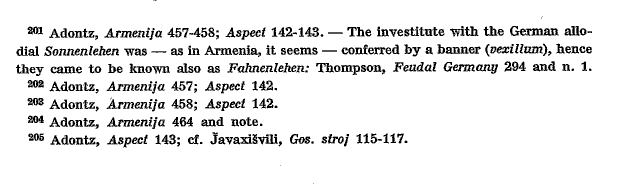
term hayrenik' ('patrimony') (201). Another kind of tenure was called k'sakagin, or 'purchased with money,' and it probably did not differ much from the allods (202). The dependence of the princes, as holders of these two kinds of domains, was clearly one of fides rather than of feudum. But there was also the other kind of dependence. It was connected with the third kind of tenure, conditional and limited: the fief or pargewakan (literally, beneficium). This was the land granted in exchange for service, which the princes occasionally held, as a dominium utile, of the king (203). More especially than with land fiefs, this dependence was connected with the office-fiefs, that is, with the Crown offices of which some of the princes were enfeoffed, and with the ducal office that was held by all of them. Thus the king of Armenia had a double aspect: he was essentially the lord paramount of the federation of dynastic and allodial princes, but at the same time he acquired, through the enfeoffment with office-fiefs, the additional character of the principal source of sovereign power and he tended to acquire, through the enfeoffment with land fiefs, also that of the chief possessor of the dominium directum. Unavoidably, this duality led to some confusion. The sources speak, on occasion, of princes as 'appointed' by the Crown to their principalities (204). Obviously, as an expression of the feudal principle and as referring to the dukedoms, which happened to be coterminous with the principalities, this is quite correct; but it is not admissible, from the dynasticist point of view, if applied to the princely States. Yet the prevalent functional and terminological ambivalence made such statements possible. However, the feudal terminology proved weaker than the dynasticist reality, and the 'appointment' meant nothing other than confimation or sanction and followed the accepted norms of genealogical succession. Likewise, the cases of forfeiture recorded in the available sources appear to present the same ambivalence, as also a conflict between the two principles. What the Crown no doubt rended to regard as a punishment of a felonious feudatory, the princes tended to consider rather a retaliatory spoliation of a weaker dynast by a more powerful one. At all events, the forfeiture did not infringe upon the rights of lawful heirs, to whom the confiscated domains eventually devolved (205).
A word must be said here on the system of succession followed in Armenia and in Caucasia in general. The succession was, in the first place, strictly agna-