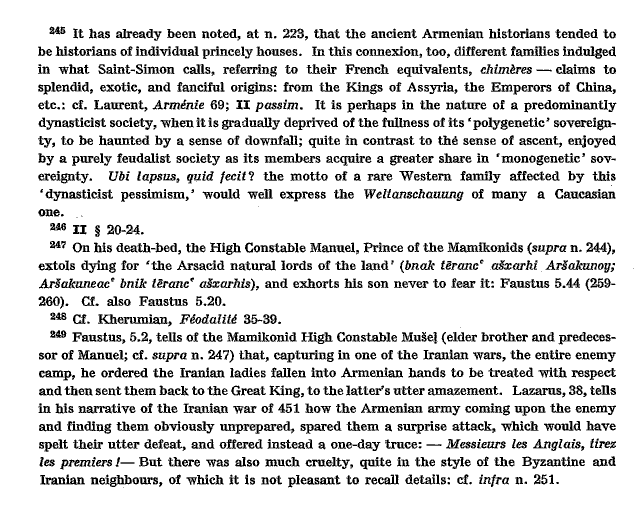
constant preoccupation with family history (245), and, perhaps to an even greater degree, with the problems of precedence. Accordingly, a complex system of precedence was evolved among the Armenian Princes which the court of Armenia and--no less--the Court of Iran were careful to respect and of which the slightest infringement might lead to armed conflicts (246). Yet this sentiment of pride was often combined with one of touching loyalty to the king (247).
The prowess of the princes and of the nobles was inherent in a knightly society spending most of its time, heavily armoured upon armoured horses, in warfare (248). It was the circumstances of geography and history that made this so, not the choice of the Armenian nobility; left to themselves, they might, we may be sure, have divided their energies between the chase and the arts. All the virtues and all the vices of a warrior class were theirs to the full. But, under the moulding influence of Christianity, these warrior virtues flowered forth into what is one of the loveliest and most spiritual blossoms among all the lay achievements of man--chivalry (249). Notable, too, in this connexion was the important and honoured position enjoyed by women in