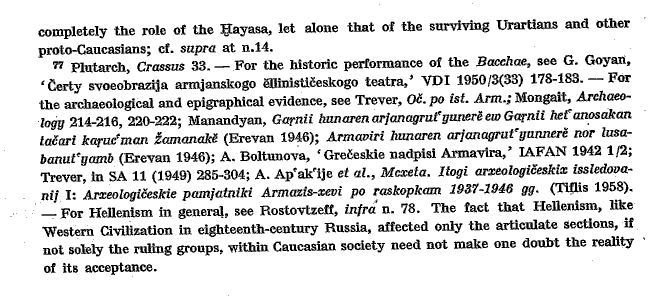
7. With Alexander the Great a new era began. His conquests effected the supersedure of the Achaemenid by the Macedonian peace and brought Hellenic cultural influence to mould the entire East Mediterranean world, and even lands beyond its frontiers. Yet, it must be borne in mind that in the world of Hellenism that had thus come into existence, the vestiges of the earlier world of 'Iranianism' were not effaced, especially in those areas which, like Caucasia, Pontus, Cappadocia, or indeed Iran itself, had been profoundly affected by the other. For Caucasia all this was of incalculable importance. An inner polarity was as a result introduced in the cultural and political aspects of existence which left a lasting imprint upon its history. Like Iran after Alexander, Caucasia was vibrant with the tension between two cultural traditions, the Iranian, itself a synthesis of earlier East Mediterranean cultures, and the Greek, which the aristocracy was eager to adopt and to spread--and of Caucasian Hellenism, the recent excavations at Garni, in Armenia, and Armazi, in Iberia, have yielded abundant evidence--while still cleaving to the other. The Armenian and Georgian dynasts of the subsequent centuries who raised Classical palaces and temples, fitting them with Greek inscriptions and Greek statuary, struck coins of the Hellenistic type, or had their effigies intagliated in the Sassanian style, displaying thereon their Iranian attire while proclaiming their Iranoid names and titles in Greek legends, offer one example of this dualism. But a more celebrated, and dramatic, example is surely Plutarch's account of how the news of the destruction of Crassus and his army was brought to the Court of Armenia, in May 53 B.C., during the performance of Euripides's Bacchae at the wedding of a prince of Parthia and a sister of King Artavasdes II of Armenia; the latter, by the way, was himself a noted Greek tragedian and historian (77). This cultural tension which the adoption of Christianity by Caucasia was, later, to heighten was a constructive one. But it was parallelled by another, a political polarity which tended to be destruc-