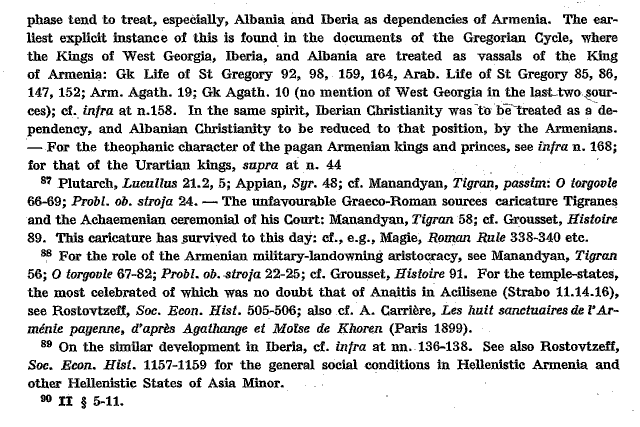
authority of the King of Kings appear to have formed, as in Urartu, two groups: the tributaries and the vassals. The rulers of the kingdoms outside Armenia belonged, obviously, to the former category. At the same time, we hear of 'many kings' paying court to Tigranes and among them of four in particular who remained inconstant attendance on him (87). These, evidently, were not foreign monarchs of the caliber of those of Atropatene or of Commagene, but, . plainly, local and lesser Armenian dynasts. The reference to the four kings, it will be seen, leaves no doubt of this, and is, besides, an important witness to the continued existence of the Armenian dynastic aristocracy under the Artaxiad Great King. These Armenian dynasts, and also temple-states of equally immemorial antiquity, formed thus the second group: the vassals (88). As for the rest of Armenian society, the crystallization of its subdivisions at the non-dynastic levels in the Artaxiad epoch has already been noted, which may mean that, as in the Urartian polity, there existed a body of the ordinary, non-sovereign noblesse (89).
There are three points to be considered in connexion with the social structure of Artaxiad Armenia, which may, by the way, indicate its continuance into the Armenia of the succeeding, Arsacid period. First, the four kings of Tigranes II survived well into that period and are frequently mentioned in Arsacid and subsequent monuments as the four vitaxae, or viceroys, of the four marches of the Great Armenian realm (90). Second, there are onomastic and genealogical