These myths were inscribed on a naos (shrine), which was found at El-Arish and later moved to the museum at Ismailia. Although the myths are of great interest in themselves, the damaged state of the shrine means that no information has survived about the context in which they were recorded. However, the place names in the text show that its original location was Saft el-Henna, and it seems likely that it was one of four shrines that were installed there in the reign of Nectanebo I; see H. Virenque, "Les quatre naos de Saft el-Henneh" ( academia.edu ).
The inscriptions were translated into German in a dissertation by H. Hohneck, "Naoi: Königliche Steindenkmäler in den Tempeln Ägyptens", vol. 2, pp.311-336 ( PDF ). Hohnecks's German has been translated into English by Donald Keith Mills ( academia.edu ), and his translation is shown here, with a few minor changes.
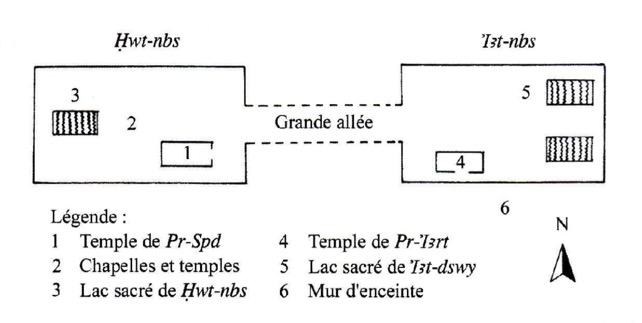
| Plan of Temple district ( from H. Virenque, op.cit., fig. 9 ) |
[A] { Left external wall }
[Once] the majesty of Shu reigned as the perfect king over heaven, earth, the underworld, the waters, the winds, the primordial waters, the mountains, and [the sea and decreed] every [order] on the throne of his father Rê-Harakhte as triumphant. Now the majesty of Shu was in [his] residence . . . . . . in Memphis. Then His Majesty spoke to the Great Ennead who were in his entourage: "Let us travel to the eastern [horizon], to my residence in Ỉȝt-nbs, so that we may see our father Rê-Harakhte on the horizon where the sun rises. We will travel [along the river] and spend a good time at our residence in Ỉȝt-nbs." They did everything as His Majesty had commanded.
The Majesty of Shu [now] went to his residence in Pr-Ỉȝrt. As a result, the entire crypt of Ḥwt-nbs [as permanent as] the sky was built on its four supports, and restoration work was carried out in the temple district of Sopdu for the majesty of Shu. It was his sanctuary that he loved [more than anything else, although] its entire construction was visible to everyone there, facing south, north, west and east. The temple was built . . . . . . more beautiful than any place that existed. Eight halls were built on the west side, eight on the eastern side and eight in the courtyard of the [eastern] horizon. [This store-house] 10 was consecrated to the majesty of Shu in his name as Sopdu, Lord of the East. The front of each hall was aligned to the front of the neighbouring hall. The crypts [belonged] to the Great [ Ennead ], to the Little Ennead, to the gods who follow Rê, and to the gods who follow Shu, and places of worship were built for . . . [in Ḥwt-nbs] around his temple. The front of this temple was oriented to the east, where Rê rises, and the inhabitants . . . . . . the temples in which each nome was represented. Now if a nome came to him, in which its order was disturbed, then this plan was made known . . . Ḥwt-nbs. Ḥwt-nbs was located on its northern side, while its front was oriented to the south. The temples in its] territory . . . [where] their fronts were oriented towards the east. [A sacred lake was on its southern side, a sacred lake] was on its northern side, and a large processional way [led] from . . . . . . opposite this temple, which reached as far as Pr-Ỉȝrt. As for Pr-Ỉȝrt, the face of Rê, the staff of the Majesty of Shu was brought to [this] site . . . . . . to the holy place in Ỉȝt-nbs. Its southern front was oriented towards Pr-Ỉȝrt, and gods, goddesses, humans and beasts were not allowed to enter it [to] see its secret. Its sanctuary was from the time of Rê, who had the great walls built in his territory, ... cubits on their four sides, 20 cubits high and 15 cubits thick. As for the sacred lake in Ỉȝt-nbs, it was ... [cubits] 20. . . distant from Ỉȝt-nbs. In the time of the majesty of Rê, Shu had created it himself. [Gods and goddesses], people and beasts had never seen it and learned its site plan. A perimeter wall had been erected around its entire district, 190 cubits long, 110 cubits wide, [20 cubits] high and 15 cubits thick. All temple work in it was carried out by workers who made secret what was hidden in [its interior].
Now the majesty of Shu had Ỉȝt-nbs built, as something that was constant [like] the sky, and all its temple complexes, which were constant like the horizon. But it happened, [when the majesty of Shu] ruled in Ỉȝt-nbs as king of the gods and administered the throne of Rê-Harakhte well, that the children of Apophis, the rebels from the region Usheru and the desert, invaded Egypt at nightfall on the way of Ỉȝt-nbs. Now what . . . . . . in Egypt, they went around in their entirety to incite them all to revolt. As for any place in which they stirred up revolt by water and by land, they had the resulting effect that it [was abandoned] by its inhabitants. As for these enemies, they came from the eastern mountain districts [on] all the roads of Ỉȝt-nbs.
Then the majesty of Shu placed the gods who follow Rê and the gods who follow [Shu, in] all [sites] in the area of Ỉȝt-nbs. They were the sites from the time of Rê, when the majesty of Rê was still in Ỉȝt-nbs. 30 [As for] the installations in Ỉȝt-nbs, they were the strongest walls of Egypt, which once repelled the rebels after Apophis had attacked Egypt. As for the gods who were in it, they were the "bulwark" of this land. They were the four pillars of heaven, which . . . guarded . . . . . . of the horizon of eternity, it was the "troop" of Shu in Ḥwt-nbs. As for those who lived in the sites of Ỉȝt-nbs, they were the country's "strike force" who . . . repelled ". . . storehouse." They were the eastern bas for [protecting] Rê-Harakhte. They were the ones who lifted Rê up from the underworld to heaven . . . . . . of heaven. They were the lords of the eastern mountain regions who rescued Rê from the hand of Apophis, who knew . . . . . . all in the region of Ḥwt-nbs, and also the gods who were there. "The Place of the Knives" { Ỉȝt-dswy } in Ỉȝt-nbs was the name of the sacred lake, [which] lay east of Ḥwt-nbs, to which the majesty of Rê had once gone, ready to fight with the associates of Apophis. ["Lake of] Flames" in Ỉȝt-nbs, located east of Ḥwt-nbs, was the name of the sacred lake . . . in Ḥwt-nbs . . .
[B] { Right external wall }
. . . . east of Ḥwt-nbs . . . with its strength, who made the "House of the Flame" . . . for the Ennead . . . the walls up to . . . Heaven . . . Re. The majesty of Shu did the same . . . . . . his desire all the gods and goddesses who were in them. . . . . . . Behbeit el-Hagar and in Ỉȝt-nbs . . . existed [in] the east of Ḥwt-nbs. It was the site . . . . . . in Behbeit el-Hagar. The storehouse . . .
[C] { Rear external wall }
. . . he had taken possession of the land, without any being able to stand up . . . before him, and there was no other god in the mouth of his troops . . . . . . with angry countenance and watchful eyes. He had built his hall among his enemies, and ruin came upon this land. There was a great uproar in the residence, because the rebels instigated the inhabitants of the Temple of Shu to revolt. Then Geb saw his mother, and he even loved her very much. His heart forgot itself for her, and the land came (?) to the point of undergoing a crisis, so that the majesty of Shu ascended to heaven with his followers. Tefnut was at the place of her appearance in Memphis. Then she moved out to the royal palace of Shu at noon, and the Greater Ennead was on the way of eternity - this is the way of his father Rê-Harakhte. [But now] the majesty of Geb sought her. Then he found her in this place named Pekhert. Then he seized her like a robber. The residence became very agitated. It was such, that Shu ascended to heaven, and no-one could come out of the residence for a span of nine days. Concerning these [nine] days, they were in turmoil; that means a storm without one being able to see another among gods and men.
The majesty of Geb, however, emerged as the crowned ruler on the throne of his father Shu. All [who dwelt in] the Residence paid homage to him. Now after 75 days had passed, Geb went to the Delta, and Shu departed to heaven. The people stood (?) at the head of his eldest son {Geb?} on the [eastern] mountains. 10 He did not go to Heliopolis with the enemies to seize the sceptre - for Degi was their name, and they lived by what the gods detest. Then [the majesty of Geb departed] to the region east of Usheru. He entered Pr-Ỉȝrt, the eastern gate of Ỉȝt-nbs, and inquired about this city from the gods of his entourage. [Then they gave] all the information about what the majesty of Rê had created in Ỉȝt-nbs, about the battles of Atum-Rê that had occurred in this place, about the strength of the majesty of Shu in this city, about the deeds of Shu [in this district,] about [the strength] of the Primordial Serpent of the Majesty of Rê, who had been with him, and about the excellent deeds of the majesty of Shu, who had beaten the enemies after putting her on his forehead. Then the majesty of Geb said, "I [too] will put her on my forehead, as my father Shu did."
Then Geb entered the Pr-Ỉȝrt, along with the gods who were with him. He stretched out his hand to seize the chest in which [the Uraeus snake] was located. The serpent came out, and in her exceedingly great rage she let her breath come alive against the majesty of Geb. Those who were in his entourage died immediately, and [the majesty of this god] was burned. Thereupon, his Majesty went to the region north of Ỉȝt-[nbs] with this burn which had been inflicted on him by the Uraeus serpent. His Majesty came to the "Field of Henna" { Sehet-henu }, while [this burn] had not yet abated. Then the gods who were in his entourage said to him, "Cause this primordial (?) serpent of Rê to be seized there, so that His Majesty may come to see its mystery. May it surround your Majesty . . . . . . on your saying so." Then the majesty of Geb caused the Uraeus serpent, which was on his head, to be brought to Pr-Ỉȝrt and a container made for her of genuine precious stones. It was hidden in the place . . . Pr-Ỉȝrt, in the quarter of the holy Uraeus serpent of Rê. As a result, this burn disappeared from the limbs of the Majesty of Geb.
After years had passed, [then the Majesty of Geb] 20 ordered that this Primordial (?) Serpent of the Majesty of Geb be brought to Pr-Ỉȝrt in Ỉȝt-nbs. It was taken to the great lake of Pr-Ỉȝrt, the "Place of Knives" { Ỉȝt-dswy } [as it was called,] to clean it there. Then this Primordial (?) Serpent turned into a crocodile. It slid into the water and became Sobek in Ỉȝt-nbs. The majesty of Rê-Harakhte had once fought with the enemies on this water called the "Place of Knives"; but the enemies could not defeat His Majesty. His Majesty Geb now went to the "Place of Knives". He transformed his figure into that of a crocodile . . . . . . with the face of a falcon and with the two horns of a bull on its head. He defeated the enemies at the "Place of Knives" in the district of Ỉȝt-nbs, and the Primordial (?) Serpent of the Majesty of Geb took this form therefore.
The majesty of Geb now appeared crowned on the throne of the four Sobek gods, Sobek-Rê, Shu, Geb and Osiris-Rê, on the throne of his father Shu as king of all gods and [goddesses], of all men and animals, as king of heaven, earth, the underworld, the primordial waters, the mountains, the winds, the sea and the stones. His Majesty was in his residence of (?), in the "Land of the henna plants" { Ta-henu }. Now His Majesty sent out the message that the foreign peoples and the Asiatics should be brought to him from their lands. Then the majesty of Geb spoke to the Great Ennead that was in his entourage: "What did my father Shu do before he appeared crowned on the throne of his father Atum, when the majesty of Shu was still in his residence in Ỉȝt-nbs?" This Great Ennead of the Majesty of Geb replied: "When your father Shu was on the throne of his father Atum, he initially defeated all the enemies of his father Atum; he destroyed the children of Apophis and killed all the enemies of his father Rê. After that, however, the winds subsided. and the two countries calmed down. The gods and the people were now in the entourage of Atum, the Lord of the Upper Egyptian Heliopolis. He then took care of the irrigation of the cities, the settlements and the nomes; he re-erected the walls of Egypt and built 30 the [gods'] temples anew in Upper and Lower Egypt."
Then the majesty of Geb said to these gods: "Tell me the names of the places that were created in the time of Rê, which His Majesty had built on earth. Name for me those districts which the majesty of Shu founded in his time. I will (?) proclaim the places of the time of the majesty of Rê in all the districts founded by the Majesty of Shu, and I will rebuild them, for I desire that they arise again in my reign." Then they read to the majesty of Geb from the Sacred Words, about . . . millions of foundations in the places that the majesty of Rê had brought to life in every nome, which the majesty of Shu had built, and which were written down at the time of the Majesty of Atum, when he was still on the earth, until Shu appeared on the throne of his father Rê and also until Geb appeared on the throne of his father Shu. The places themselves (?) call the districts by their name, with the exception of the districts founded by the Majesty of Rê in his time.
Attalus' home page | 09.11.26 | Any comments?